The Five Books for A Season of Seeing
There is a kind of reading that changes not just what you know but how you see. Charlotte Mason understood this. She believed that a book worth reading was one that left the reader more awake to the world. More attentive, more responsive, more genuinely present to the life unfolding in front of her.
This summer, I have been building a program around that conviction. It is called A Mother’s Education Summer: A Season of Seeing, and enrollment opens June 1. The program is twelve weeks of reading, noticing, and tending the interior life through a carefully chosen set of books and practices drawn from Mason's philosophy of attention.
The reading list is five books. Each one was chosen because it teaches a specific form of attention — to people, to language, to the practice of notebooking, to the natural world, and to the way literature shapes how we see a place. Together they form what I hope will feel, by the end of summer, like a complete education in seeing.
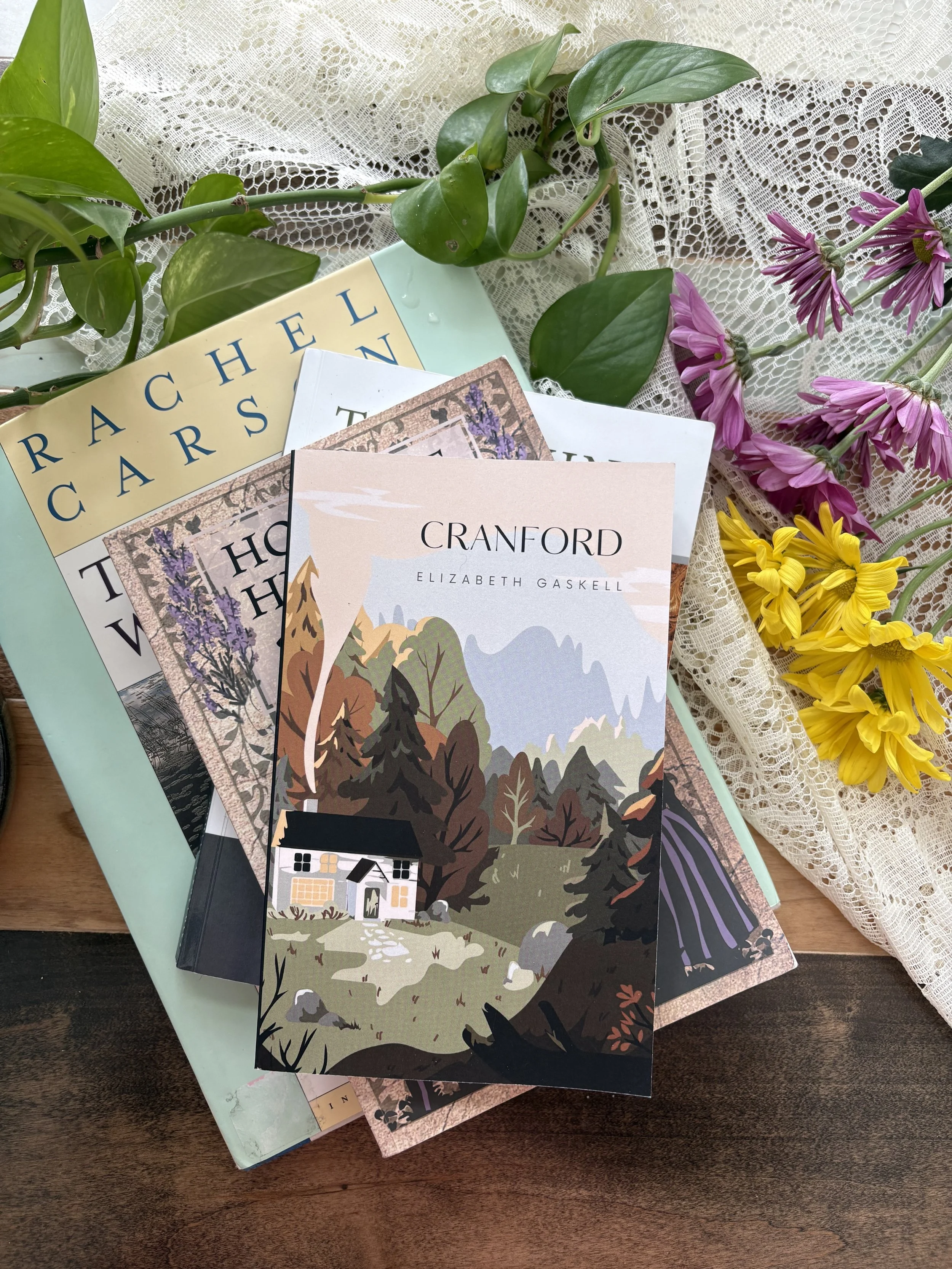
Cranford — Elizabeth Gaskell
I am coming to Cranford this summer for the first time, alongside the mothers in this program: sometimes the right book arrives not when you are ready for it but when you are reading it with the right people at the right season of your life.
What I know of Gaskell's novel is this — it is set in a small English town populated almost entirely by women, women of modest circumstances and narrow horizons who possess an extraordinary capacity for dignity, tenderness, and the kind of domestic grace that the literary tradition has not always known how to honor. Gaskell sees them with complete clarity and complete warmth, and that combination is exactly the quality of attention I want to be practicing all summer.
Gladiola Garden — Effie Lee Newsome
I chose this book for the mothers who are convinced they do not like poetry. I chose it especially for them.
Effie Lee Newsome's Gladiola Garden is a collection of poems that does not ask very much of you before it gives you everything. The poems are delightful — genuinely, uncomplicated-ly delightful — and they are the kind of thing that a mother can read aloud to herself or to her children and feel, perhaps for the first time in a while, that poetry is not a performance to be endured but a pleasure to be had.
There is a place in the formation of the reading mother for the book that simply gives without demanding. Gladiola Garden is that book in this collection. It is also, for those who are willing to look more closely, a quietly serious act of attention to the natural world, Newsome sees flowers and seasons and small creatures with the same loving specificity that Mason asked of her students in their nature notebooks. The delight is the surface. The attention is the substance.
If you are someone who has long felt that poetry was not for you, I would like to gently suggest that you have perhaps not yet met the right poem. Newsome may be the introduction.
The Living Page — Laurie Bestvater
If you have not read The Living Page, I want you to know before you begin the summer that it will change how you read everything else on this list. Bestvater has written the most serious and beautiful account I know of what Charlotte Mason meant by the commonplace book, what it is, what it is for, and what it does to a person who keeps one faithfully over years.
Mason's understanding of the commonplace book was not decorative. She believed it was a practice of formation and that the act of writing down what arrests you, and returning to it, and allowing it to accumulate over time, was one of the ways a person built an interior life worth having. Bestvater makes this case with scholarly rigor and genuine warmth, and she does it in prose that itself demonstrates the principle she is arguing for.
The Living Page teaches attention to what strikes you and then asks you to honor it, to hold it, to let it become part of who you are.
I recommend jumping head first into this one and joining in our band discussions. It will change how you engage with every other book in the collection. Keep a notebook nearby from the first page.
A Sense of Wonder — Rachel Carson
Rachel Carson's A Sense of Wonder is ninety pages long and it is one of the most quietly transformative books I have ever read. It began as a magazine essay and was published posthumously as a small book, and its brevity is part of its power it has the concentrated force of something that knows exactly what it wants to say and says only that.
Carson writes about what it means to experience the natural world with a child beside you, and how the child's capacity for astonishment, if we protect it rather than explain it away can restore in adults something we think we have outgrown. She is writing about wonder as a faculty, not a feeling, and she is arguing that it is cultivable at any age by anyone willing to go outside and actually look.
Carson understood what Mason understood: that you cannot give a child a sense of wonder you do not yourself possess. The mother's cultivation of attention is not separate from the child's formation. It is the ground of it.
This book belongs in this collection because it is the most direct expression of what the whole summer is about. Go outside after you read it. You will not be able to help yourself.
How the Heather Looks — Joan Bodger
How the Heather Looks is the most surprising book on this list, and in some ways the one I am most excited to read alongside the other mothers in the program. It is a memoir of a family journey. Bodger, her husband, and their two young children traveling through England and Scotland in the 1950s in search of the landscapes that gave birth to the children's books they loved.
Bodger is looking for the moors of The Secret Garden and the riverbanks of The Wind in the Willows and the hills behind Beatrix Potter's farm, and what she finds is something richer than location scouting: she finds that the books and the landscapes and the children looking at both of them are all part of the same conversation, that literature shapes how we see a physical world and a physical world shapes how we read a book.
How the Heather Looks teaches attention to place and to the relationship between the stories we love and the world we actually inhabit.
It is also simply a beautiful and funny and moving book about what it is to travel with children who are seeing everything for the first time, which makes it perhaps the most maternal of the five. Mason believed deeply in the formative power of place and of the stories attached to place. Bodger illustrates that belief in the most vivid possible way.
On Reading These Books Together
I did not choose these five books because they are all about the same thing. I chose them because they each illuminate a different facet of the same practice, the practice of attention that Mason believed was at the heart of a living education, for the mother as much as for the child.
Gaskell teaches us to look at people. Newsome teaches us that delight is its own form of attention, and that beauty does not require difficulty to be formative. Bestvater teaches us to honor what we notice by writing it down. Carson teaches us that wonder is not something we outgrow but something we must tend. Bodger teaches us that the stories we love and the places we inhabit are in conversation with each other in ways we are only beginning to understand.
Together, over twelve weeks, I believe these books will do something to a mother who reads them with intention. Not add to her knowledge, exactly. Change what she is able to see.
A Season of Seeing opens June 1. The program is twelve weeks of reading, weekly practices, and a community of mothers reading alongside you. The digital program is $22.
The box — which includes the program plus a handmade shepherd's hook bookmark, book darts and a commonplacing card, a printed copy of the program, and a piece of art chosen for the season — is $55 and is limited.