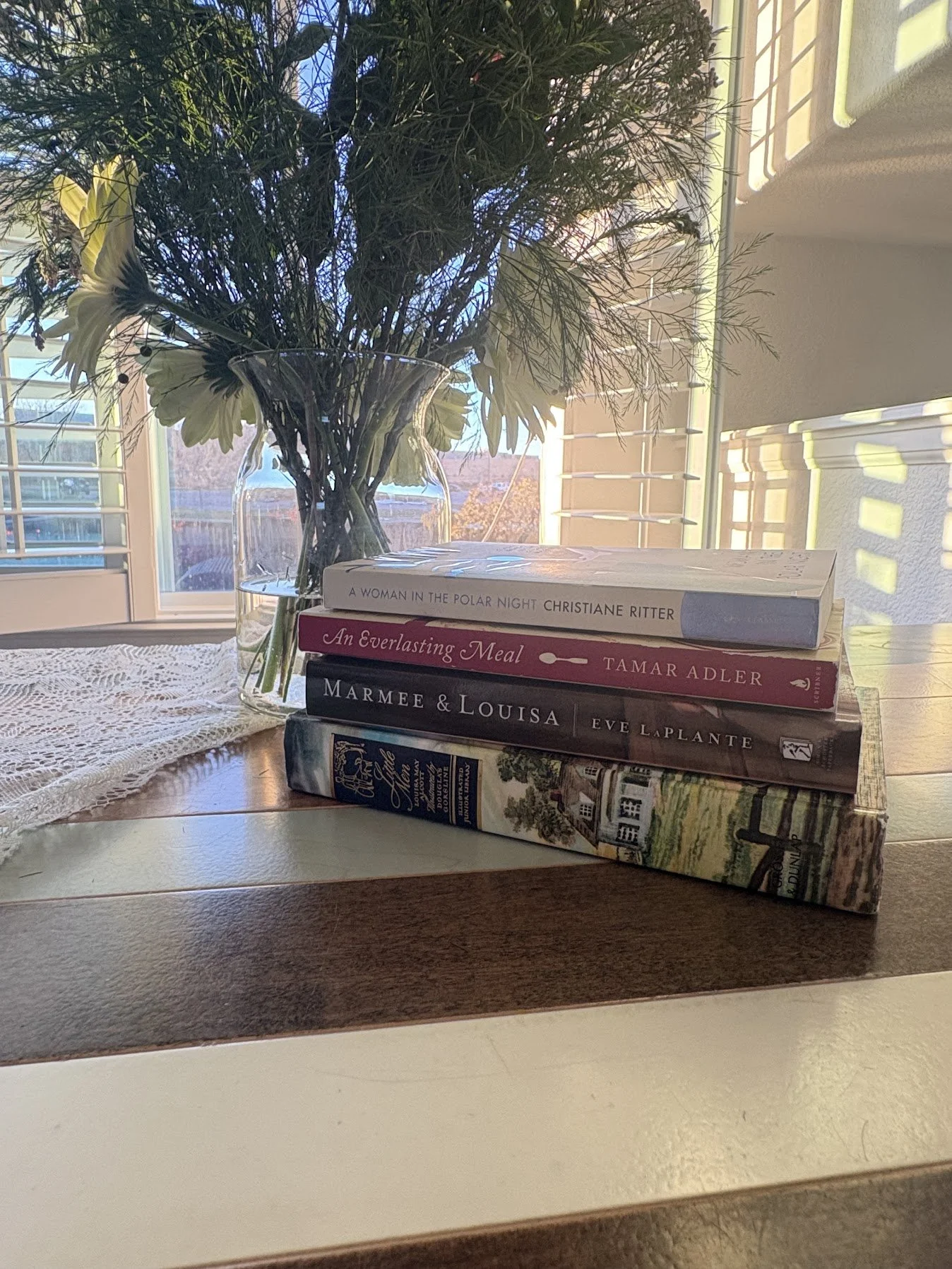
This winter we will spend much of our time with the Alcotts, beginning with Little Men, the novel Louisa May Alcott wrote as a sequel to Little Women. In this story, Jo March has grown into a mother and a teacher, and together with her husband, Professor Bhaer, she has opened her home at Plumfield to a houseful of boys who arrive with all sorts of rough edges. Each boy is given a garden plot of his own to tend, and Jo keeps a book in which she records how each one is growing in character from week to week. Readers who know Charlotte Mason will see aspects of her philosophy when they visit Plumfield, where the atmosphere of a loving home and steady attention to habits do the teaching. Readers who are new to her will find a beautiful picture of what a living education can look like in a house full of children.
Alongside it, we will read Marmee & Louisa, Eve LaPlante’s biography of Abigail May Alcott, the real mother behind Marmee. LaPlante is herself a descendant of the May family, and she draws on Abigail’s own letters and journals to tell the story of a woman who kept reading and writing through years of hardship and frequent moves while raising four daughters. Abigail encouraged Louisa’s writing from girlhood, and she lived to see her daughter publish Little Women. Reading the two books together lets you hold the imagined Plumfield beside the real household that inspired it, and you may find that the mothering Jo offers her boys drew inspiration from the mother Louisa watched at home.
A winter in the far north
Christiane Ritter’s A Woman in the Polar Night will carry us to a small hut on the Arctic island of Spitsbergen. Ritter was an Austrian painter who left a comfortable home in 1934 to join her husband for a year in the Arctic, sharing the hut with him and a Norwegian hunter many miles from the nearest neighbor. She went uncertain of what the dark months would hold. Over that winter she came to see a beauty in the snow and the long Arctic night that stayed with her for the rest of her life. Her painter’s eye fills the book with color and light even in the weeks when the sun never rises. I believe this makes her a wonderful companion for a season when our own days are short.
In the kitchen
Tamar Adler’s An Everlasting Meal will keep us company at the stove. She begins with a pot of boiling water (heavily salted) and builds from there, showing in essay after essay how the ends of one meal become the beginning of the next, so that the bones from a roast chicken or the stems from a bunch of greens are treated as ingredients for tomorrow’s cooking. Her writing is thrifty and generous at once, and she brings a real sense of art to the daily work of feeding the people we love.
A poem each morning
Each day you will read a Robert Frost poem of your choice. His poems are full of snowy woods and old New England farms, and many of them, like “Stopping by Woods on a Snowy Evening” and “Dust of Snow,” are short enough to read with your first cup of coffee before the house wakes. A single poem read at the start of the day has a way of staying with you through the morning’s lessons and the afternoon’s chores. By the end of the season you will have come to know one poet well.
Picture study with Grandma Moses
For picture study, we will spend the season with Grandma Moses, whose given name was Anna Mary Robertson Moses. If picture study is new to you, it is the simple practice of looking closely at one painting for a few minutes until you can see it with your eyes closed, and Grandma Moses is a welcoming artist to begin with. She painted the farms and villages of upstate New York. However, she began painting seriously only in her late seventies, after a lifetime of raising children and keeping a farmhouse, when arthritis had made her embroidery too difficult to continue. She worked from memory. Her canvases are full of families gathering maple sap in the snow and celebrating together through every kind of weather. She kept painting past her hundredth birthday, and her own life is a beautiful picture of a woman who kept learning in every season she was given.
For your home this winter
My hope is that what you read this winter will find its way into your home, into the conversations at your table and the way you notice the snow on the walk to the mailbox, and that your children will be blessed by a mother who is still growing in truth, beauty, and goodness. Read as your days allow, return to the poems and paintings whenever you have a few minutes, and know that I am so glad to be spending these winter months with you.